Job opening

Program Manager at the Sustainability Impact Accelerator (SIA)

Location: Stockholm, Sweden

Contract Type: 3-year project contract with possibility of fixed-term, 6 months’ probation 

Start Date: As soon as possible

Please note: Successful candidates must have the right to work and reside in Sweden. NIR is not able to sponsor work or residence permits.


Your Role

This is a full-time on-site role based in Stockholm for a Program Manager at the Sustainability Impact Accelerator. In this role, you will design, execute, and oversee capacity development programs aimed at accelerating sustainable infrastructure projects in low- and middle-income countries. Your responsibilities will include project management, stakeholder engagement, resource planning, reporting, and continuously identifying opportunities for impact. Additionally, you will collaborate with cross-functional teams and external partners within Team Sweden to coordinate around the delivery of the infrastructure projects.

Qualifications

  • Academic degree in Civil Engineering, Economics or Social Sciences, or a related relevant degree, with a focus on transport, energy and sustainability.
  • Minimum of 5 years of relevant work experience, with a proven track record in project management, or a similar role. Work experience from the transport or energy sectorsis an advantage, as well as experience of applying international lender standards in these sectors (IFC Performance Standards, UN Guiding Principles and related standards).
  • Demonstrated experience in project management and working in international development contexts, collaborating with cross-cultural teams in international contexts
  • Ability to work independently and manage multiple projects simultaneously
  • Professional fluency in English is required, and proficiency in Swedish is required. Proficiency in French, Spanish, Portuguese or Arabic is an advantage.
  • Strong analytical skills, with the ability to develop and manage budgets, reports, and strategic plans.
  • Excellent interpersonal and communication skills, with the ability to engage and collaborate with diverse stakeholders.
  • Passion for sustainable development, with strong integrity regarding human rights, environmental protection, and labor rights.
  • Ability to convey NIR’s core values in the daily work, including respect and trust.

What we offer

  • An opportunity to work with a key development cooperation program that has global impact and contributes to sustainable development and improved business conditions in low- and middle-income countries.
  • A collaborative and supportive work environment within a dedicated and passionate team.
  • Competitive salary and benefits package.
  • Flexible working hours with the option to work remotely part of the week.
EXECUTIVE SUMMARY

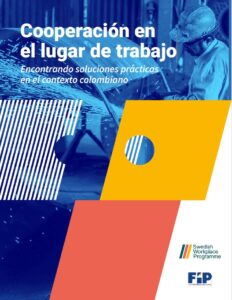
This executive summary presents the findings from the study “Workplace Cooperation: Finding Practical Solutions in the Colombian Context,” conducted by the Fundación Ideas para la Paz (FIP). The study evaluates the added value of the Swedish Workplace Programme (SWP) dialogue and cooperation model within the Colombian labor market.

Throughout 2022, FIP dedicated efforts to thoroughly understand the SWP model, including its concept, foundations, implementation process, and contributions to the labor market. In 2023, FIP documented the experiences of three companies—SKF Latin Trade, Securitas, and Epiroc—that implemented the SWP model in practice. The study also included face-to-face workshops to gather feedback from various stakeholders including civil society, businesses, government, academia, and international cooperation. The findings suggest that the SWP model has the potential to strengthen labor relations, contribute to decent work, and resolve workplace conflicts in Colombia.

The case studies highlight the importance of collaboration between employers and workers to promote decent work and sustainable development in Colombia. They demonstrate that social dialogue facilitates worker participation in labor decision-making, enhances their representativeness, and promotes cooperation between employers and employees, thus improving labor relations and contributing to the well-being of both employees and companies.

The SWP model is particularly noted for improving workplace relationships and commitment to jointly finding solutions to challenges faced by workers and the company. It empowers workers, enhances leadership, and helps integrate business policies into daily practices, reducing the initial disconnect between management objectives and the day-to-day realities of workers. The study also highlights the model’s capacity to manage conflicts constructively, transforming the perception of conflict as an opportunity for improvement. Structured dialogues deepen understanding of the underlying causes of conflicts, fostering empathy and facilitating effective resolution. This promotes a culture of collaboration and a democratic approach to decision-making, building trust.

Additionally, the model is recognized for enabling workers to make decisions, identify challenges, and propose solutions that impact their well-being, and bridging gender gaps in the workplace. Its inclusive approach adapts to the unique needs and characteristics of each company, promoting a stronger and more diverse organizational culture. It also drives good work performance and productivity by involving workers in problem identification and resolution, as well as in implementing improvements and efficiently identifying ESG (Environmental, Social, and Governance) risks for companies.

The document identifies the SWP model’s added value in empowering direct interaction among labor stakeholders in Colombia, overcoming historical or cultural reservations, and contributing to the development of stronger labor relations and improved workplace environments in the country.

Challenges and opportunities of the model are also discussed. The study points out the importance of addressing value chain risks, particularly in a global context where corporate clients demand decent work processes and due diligence. It emphasizes the need to integrate SMEs into this process and use anchor companies as drivers of social dialogue throughout the value chain. The role of the state in social dialogue and the importance of highlighting the benefits of the model for adoption across various business sectors are discussed.

The opportunities of the model include raising awareness of human rights in the workplace in line with the United Nations Guiding Principles (UNGP), to strengthen due diligence, manage risks, promote long-term sustainability, and improve organizational culture. The document also underscores the importance of involving workers in change processes, leveraging their insights for continuous improvement of processes, and fostering innovation opportunities. Lastly, it suggests replicating the model in value chains to address work environment risks and gender biases, involving suppliers and contractors, and integrating the model into corporate policies to strengthen existing programs and transform organizational culture towards resource efficiency and effective participation of employers and workers.