A Story of Change
Towards an inclusive water management model in Argentina's Puna
As lithium exploration expands across the Puna, concerns over freshwater are growing in this fragile landscape. In closed watersheds containing salt flats, wetlands and shallow lakes sustain local ecosystems and the daily lives of communities such as Santa Rosa de los Pastos Grandes.
In Pastos Grandes, the absence of major social conflict created a valuable opportunity to advance more inclusive, participatory water decision-making and to generate lessons for similar processes in other territories.
As Lithium is central to the global energy transition, via its role in the producion of batteries, this cirtical raw material creates economic opportunities while simultaneously raising important questions about how water is managed, protected, and shared.
Building a shared approach to inclusive water management
The initiative aims to strengthen inclusive water governance early in the mining cycle in the Salar de los Pastos Grandes watershed, where no watershed-scale tool existed to support the development of a shared understanding of water availability and ecosystem dynamics. Responding to this situation, the process is building the technical, institutional and territorial relational capacities for meaningful and long-term engagement.
The proposed solution follows a process structured around four intermediate goals, which also represent progressive stages of implementation. The first, completed in 2025, focused on creating better conditions for engagement to support the inclusive construction of the Water Model.
The second, currently underway in 2026, focuses on strengthening stakeholder capacities through the co-construction and refinement of the water model. The following stages will advance towards a participatory water management plan for Pastos Grandes and, by 2027, the consolidation of a future inter-provincial Waterwise Protocol for lithium-producing salars. The results and progress presented below relate mainly to the first completed stage and the second stage now in progress.
Table of Contents
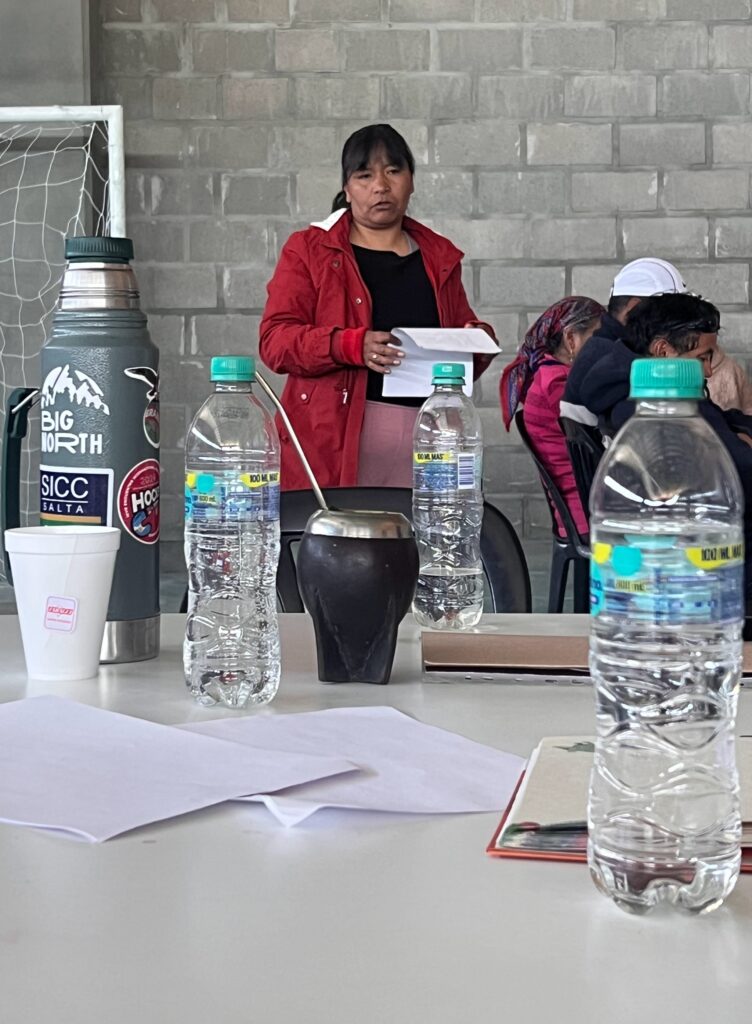
Community dialogue in Salar de Pastos Grandes, 2025. Unlike other parts of Salta Province, Pastos Grandes face growing pressure from lithium development without major social conflict, creating a rare opportunity to pilot more inclusive and participatory water governance in a context of fragmented institutional decision making. (Photo: MARS)
Progress and Results
Improved conditions to advance the inclusive Water Model construction (2024-2025)
Progress during the first phase has been meaningful. As the co-development of an inclusive water management model advances in Pastos Grandes, early shifts are beginning to emerge toward a more inclusive and legitimate process, built around a common reference point and enabling more consistent engagement among actors whose interests do not always align.
This shift is reflected in the participation of Lithium Argentina, the Secretariat of Mining and Energy of Salta Province, the Secretariat of Water Resources of Salta Province, and the governing committee of Santa Rosa de los Pastos Grandes, all of whom signed agreements to engage in the model co-construction process.
Transparency has increasingly become a shared demand. This is evidenced by Lithium Argentina’s sharing of roughly two years of hydroclimatic data with SEI Latin America, and by subsequent discussions with the company’s technical team on how that data should be used in the watershed model. The process has also made it clear that the model’s scope, assumptions, and uncertainty must be communicated clearly to all parties.
These early shifts are already translating into tangible effects across different stakeholder groups. In the private sector, Lithium Argentina has moved beyond engagement limited to technical experts and is now involving legal and public relations functions integrating a more holistic view within the enterprise.
Participation was driven less by trust than by necessity: a shared recognition that, without collaboration, no legitimate watershed-scale understanding of water resources could be achieved.
On the public side, the Secretariat of Mining and Energy and the Secretariat of Water Resources have committed to participate on the basis that the model can support technical review, staff training, and a future validation process. The Environment Secretariat is also identified in the initial context as a relevant authority responsible for biodiversity and critical ecosystems, underscoring the need for integrated decision-making.
Community participation is also gaining a clearer role. The agreement with the governing committee of Santa Rosa de los Pastos Grandes includes support for organizing workshops and for identifying community members with specific knowledge of water resources, aquatic ecosystems, and their relationship to local livelihoods.
In parallel, the process is being technically strengthened through an expert council led by the National University of La Plata, with anticipated contributions from the National University of Salta to address gaps in endorheic watershed modelling, wetland ecology and community livelihoods in the Argentine Puna.
Strengthening stakeholder capacities through the Water Model: When dialogue needs data, and data needs trust (2026)
During the second phase of the project in 2026, the Impact Project has moved from establishing enabling conditions for collaboration toward consolidating the co-construction of the water management model in Pastos Grandes. The process has focused on strengthening stakeholder capacities, supporting more active participation, and helping different actors representatives engage with the variables, data, and knowledge needed to inform shared water management decisions.
This work is being reinforced by the Expert Council, which continues to strengthen the credibility and technical basis of the process. By bringing expertise in hydrological and hydrogeological modelling, aquatic ecosystems, water resources, and local livelihood systems, the Council is contributing to refine and validate mining company and government data with community knowledge.
Through this role, the Expert Council is supporting the model’s development as both a technical tool and a shared reference point for dialogue. These efforts are now leading to the November 2026 workshop, where mining company representatives, provincial authorities, and community representatives will review key uncertainties, performance metrics, and final adjustments to support long-term decision-making, monitoring, and adaptive management.
At the same time, the project is beginning to connect the local process in Pastos Grandes with broader institutional learning on water-wise lithium development in Argentina. Since May 2026, collaboration with the Intergovernmental Forum on Mining, Minerals, Metals and Sustainable Development has advanced as a basis for establishing an inter-provincial protocol. This work will assess regulatory frameworks for water management and aquatic ecosystem protection in Catamarca, Salta, and Jujuy, three central provinces for lithium production in Argentina.
Building on this, the 2026 SWPA–UNDP collaboration will strengthen engagement with public and private decision-makers to support informed, multi-stakeholder water negotiations in lithium-producing salars.
“It will be something of our own, not data provided by companies, but data generated by the community itself.”
Woman Community leader
Pastos Grandes, Argentina
Contact MARS for more information
Our Partners